You are here
Privacy Policy

Article (1): Introduction
Article (2): Data to be Collected and Purpose of Collection
- Name
- Mobile number
- Email address
- Age
- Gender
Name and email are used to complete registration; mobile number is used to ensure delivery of donation messages and impact reports. Age and gender are optional data the donor may add to improve user experience.
Article (3): Methods of Data Collection
- Directly: donor data provided by the data subject is collected through direct registration on the website/app.
- Indirectly: Ehsan does not collect any personal data indirectly and does not rely on any other sources for donor data.
Article (4): Use of Personal Data
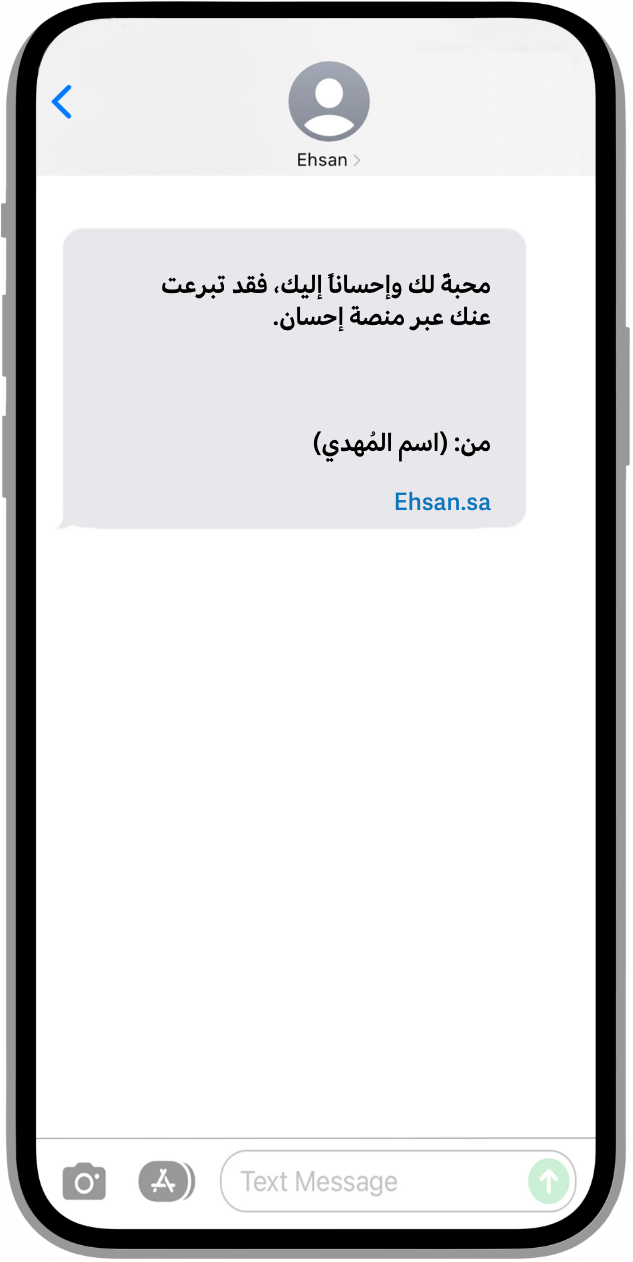
We use the personal data collected directly as follows:Personal data is used to fulfill account-creation requirements (name, email, and mobile number) to complete registration; to sign in by entering the mobile number; or via “Keep me informed” after completing a donation by entering the mobile number. Data is stored in Ehsan’s databases in encrypted records and linked to sending SMS messages to donors targeted by donation opportunities to improve beneficiary experience—such as notifying donors about request status in specific programs (campaigns, Adahi, Gift) and sharing impact reports for certain opportunities—until deleted in accordance with the National Information Center’s data destruction procedures.
Article (5): Storage and Destruction of Personal Data
Article (6): Legal Basis for Collecting and Processing Personal Data
Article (7): Rights of the Data Subject
Right to be informed: the data subject has the right to know how we collect data, the legal basis for collection and processing, how it is processed, stored, and destroyed, and with whom it will be shared. All details are available in this Privacy Policy, or by contacting us via the details in Article Nine.
Right of access: the data subject has the right to be enabled to access their personal data directly.
Right to obtain personal data: the data subject may request a copy of their personal data via the email specified in Article Nine. It will be provided—free of charge—within [seven business days] via email.
Right to rectify: the data subject may request correction of personal data they deem inaccurate, incorrect, or incomplete via the email specified in Article Nine; it will be reviewed and updated within [seven business days], and the data subject will be notified by email.
Right to destroy personal data: the data subject may request destruction of their personal data under certain circumstances, except for data linked to the organization’s core donation operations.
Withdrawal of consent: the data subject may withdraw consent to the processing of personal data at any time, unless there are legitimate purposes requiring otherwise.
Article (8): Sharing/Exchange of Personal Data
Article (9): Exercising Data Subject Rights
The data subject may request access/rectification/destruction of their data by contacting: EData@nic.gov.sa
Article (10): Complaints and Inquiries
If you have any complaints or inquiries regarding the Privacy Policy or the handling of personal data, please contact Ehsan Foundation through its available communication channels at 8001247000.
Article (11): Updates to the Privacy Policy
This Privacy Policy was last updated on January 23, 2025.
Ehsan Foundation reserves the right to add to or amend any provision of this Privacy Policy. The Foundation will notify the Data Subject of any amendment. The website management may terminate the Data Subject’s account if the Data Subject does not accept any amendment to this Privacy Policy.
Arabic is the official language governing the application of the Terms and Conditions. In the event of any dispute concerning the interpretation of any text in another language, the Arabic text shall prevail.